What Is Tenthlining and Why Kenyan Courts Require It
By Admin Cook · August 15, 2026 · 6 min read
Your clerk uploads a pleading through the Judiciary of Kenya E-Filing System. In the evening, it gets rejected because the margin doesn't have line numbers on every tenth line. No one told you this was a filing requirement. You just lost a day, and you have to fix the PDF and resubmit it through the system from scratch.
This happens because of a rule called tenthlining.
What tenthlining actually means
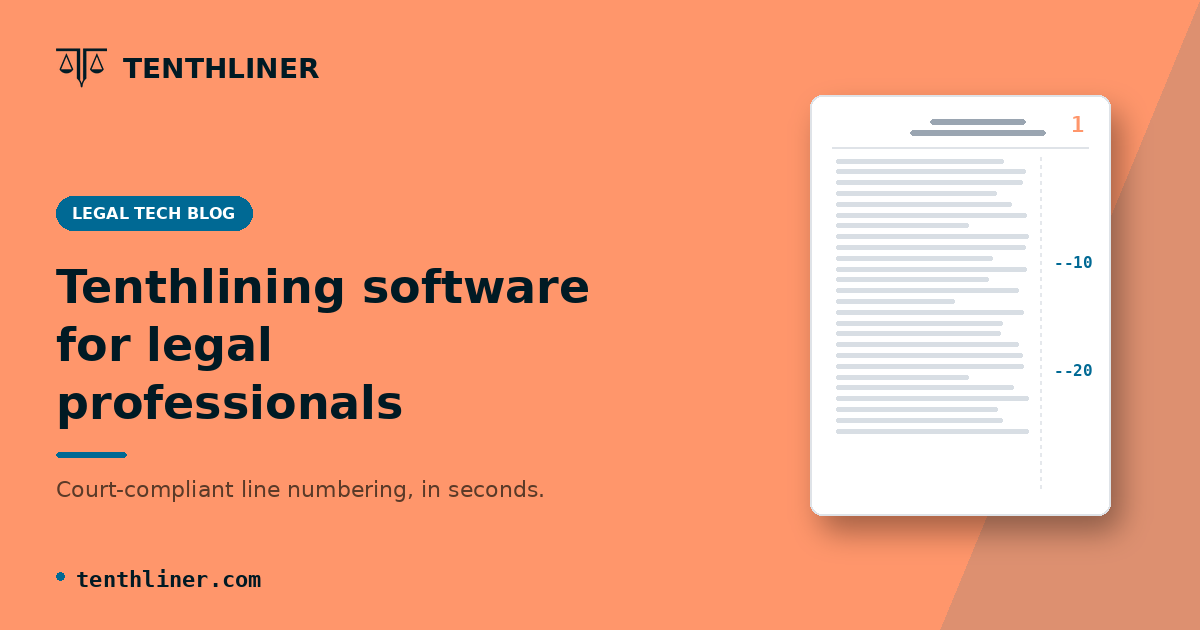
Tenthlining is the practice of numbering every tenth line of a legal document in the right-hand margin, in addition to the ordinary page numbers in the corner. Line 10, line 20, line 30, and so on, all the way down the page. You'll also see it spelled "tenth lining" or "tenth-lining." All three refer to the same thing.
The point isn't decoration. It gives everyone in the process- the judge, opposing counsel, the registry staff reviewing your submission on the e-filing system- a way to point to one exact line without ambiguity. "The admission on page 3, line 40" means something specific when the document is tenthlined. Without it, you're stuck saying "somewhere in the third paragraph," which is not how courts like to work.
Why courts made this a requirement, not a suggestion
Kenya's courts aren't asking for tenthlining as a courtesy. It's written into the practice directions that govern how documents are filed, and a filing that doesn't comply can be rejected on the e-filing system before it ever reaches a judge.
The clearest statement of the rule comes from the Supreme Court (General) Practice Directions, 2020, Paragraph 11:
"The pages of each document shall be consecutively numbered, on the top right-hand corner and every tenth line of each document shall be numbered in sequence, on the right-hand margin."
That's not a stylistic preference. It's a formatting rule with the same weight as a page limit or a font requirement, and it's enforced the same way any other filing defect is: the submission gets flagged and sent back.
The Court of Appeal and the High Court apply the same underlying rule in their own practice directions, covering documents like memoranda of appeal, affidavits, written submissions, and records of appeal. The exact wording differs slightly by court, so if you need the precise citation for each one, the full breakdown is on our tenthlining explainer page, with direct links to the source documents on Kenya Law.
Doesn't the Constitution say technicalities shouldn't matter?
This is worth addressing directly, because advocates raise it often. Article 159(2)(d) of the Constitution of Kenya says "justice shall be administered without undue regard to procedural technicalities." It's one of the most cited provisions in Kenyan civil practice, and it exists to stop courts from throwing out a good case over a minor slip.
Tenthlining isn't the kind of technicality that provision was written for. It's not an obscure trap; it's a published, standing formatting rule that applies to every document filed in the relevant court, known in advance and equally easy to comply with for every party. Courts have generally treated deliberate, standing formatting requirements like this differently from one-off procedural slips, since ignoring the rule for one filer and not another would undermine the consistency Article 159(2)(d) is meant to protect, not serve it. Article 48 points the same way: it requires the State to keep the process of getting to court reasonable, not to remove the process altogether.
None of this is a guarantee of how a specific judge will rule on a specific objection; it's context for why "the Constitution says technicalities don't count" isn't a safe basis for skipping tenthlining. If it matters to a live case, get an advocate's view on it.
How rejection actually happens on the e-filing system
Since Chief Justice Martha Koome's directive that, from 1 July 2024, no court should be printing pleadings and documents, filing has moved onto The Judiciary of Kenya E-Filing System at efiling.court.go.ke, built on the Electronic Case Management Practice Directions of 2020. There's no clerk physically handing a bundle across a counter to be checked; there's a PDF uploaded through the system, reviewed against the same practice directions as before, and either accepted or rejected inside the system itself.
That changes the mechanics of a rejection, not whether it happens. If the tenthlining is wrong, the rejection shows up as a status on the case in the e-filing system rather than an unstamped bundle handed back at a desk, but the outcome is the same: you fix the document and go through the upload again, on top of whatever else was flagged. The document has to be correct before it goes in, because the check happens on the exact PDF you submit, not on paper you can hand-correct at the counter.
What happens when you skip it
A rejected filing isn't just an inconvenience. Depending on where you are in the process, it can mean:
- Missing a filing deadline because the corrected document has to be re-uploaded to the e-filing system and re-queued for review behind everyone else's.
- A client asking why a straightforward filing took three attempts.
- Reformatting an entire bundle by hand under time pressure, which is exactly when mistakes creep in.
None of this is because the legal argument was weak. It's because a document that should have taken minutes to prepare correctly ended up costing a full business day.
Why this trips people up so often
Tenthlining isn't hard to understand once someone explains it, but it's easy to get wrong in practice, for a few reasons:
It's invisible until it's checked. A document can look complete and well-argued and still fail on a formatting technicality that has nothing to do with its substance.
Manual line numbering doesn't survive edits. If you place numbered text boxes down the margin in Word or Adobe and then edit the document, every edit that reflows the text pushes those numbers out of alignment. You end up re-checking the whole document by hand before every upload, which most people don't have time to do properly.
It applies to scanned and handwritten documents too, not just documents typed from scratch. A supporting affidavit signed and scanned in has to meet the same standard as a document drafted in Word, which manual tools handle badly, and it still has to be tenthlined correctly before it's uploaded.
Getting it right without doing it by hand
The reliable fix is to stop treating tenthlining as a manual formatting step and treat it as something the document produces automatically before it's uploaded. That's the whole premise behind Tenthliner: upload a PDF, scanned document, or handwritten filing, and get back a correctly tenthlined, e-filing-ready version in seconds, with the numbering staying accurate regardless of how the original document was produced.
If you want the complete legal picture, including the exact Court of Appeal and High Court provisions and how Kenya's rule compares to line-numbering conventions in other common-law jurisdictions, that's covered in full on our tenthlining explainer page.
If you just want to stop getting filings rejected on the e-filing system, try Tenthliner free: 50 credits, no card required.