Tenthlining vs. Line Numbering: Are They the Same Thing?
By Admin Cook · August 18, 2026 · 3 min read
Search for "line numbering software" and you'll find tools built for California pleadings, numbering every single line down the left margin. Search for "tenthlining" and you'll land on tools built for Kenyan court filings, numbering only every tenth line, on the right. Both get called "line numbering." Only one of them will get your Kenyan filing accepted.
If you've ever wondered whether tenthlining is just Kenya's word for line numbering, or a genuinely different rule, here's the actual distinction.
Line numbering is the general category
"Line numbering" isn't a specific rule; it's a description of an entire family of court formatting requirements found across common-law jurisdictions. The shared idea is simple: number the lines of a legal document so anyone can reference an exact spot in it. Beyond that shared idea, jurisdictions disagree on almost everything else:
- Which lines get numbered. Some courts number every line. Others, like Kenya's, number every tenth line.
- Which margin the numbers go in. Left margin is common in the United States. Kenya's rule puts them on the right.
- How numbering relates to page numbers. In Kenya's rule, tenth-line numbers and page numbers are separate and both required. Elsewhere, a single numbering scheme sometimes does both jobs.
So when someone says "line numbering," they could mean any of several different, mutually incompatible formatting rules depending on which court they're talking about.
Tenthlining is one specific rule within that category
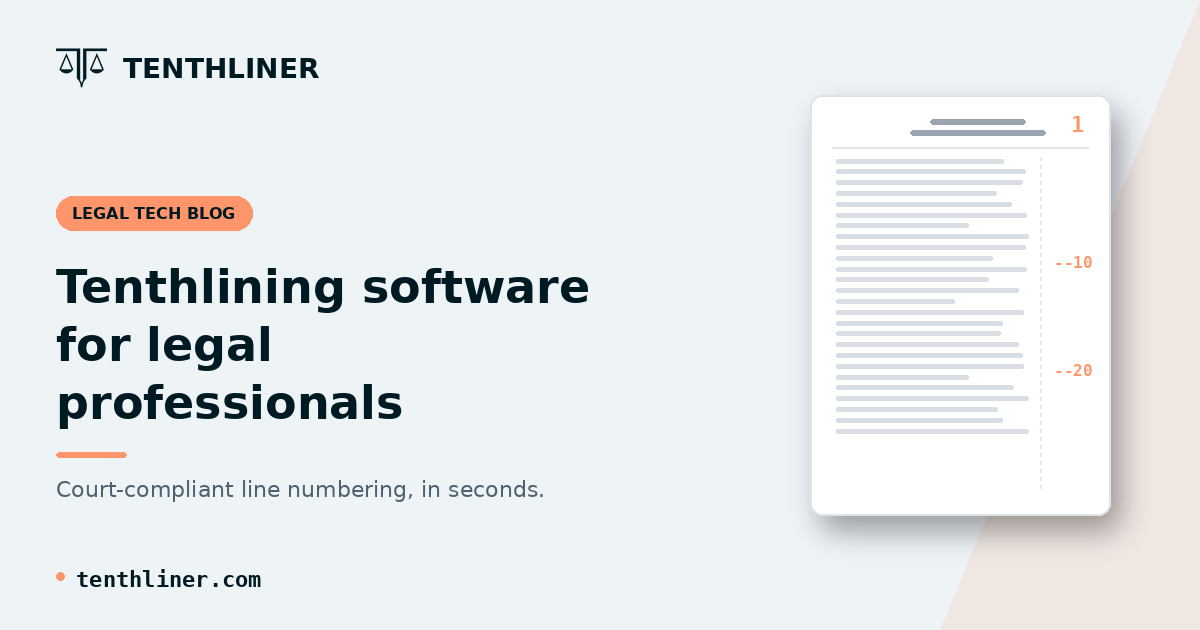
Tenthlining is Kenya's version: number every tenth line, in the right-hand margin, in addition to ordinary page numbers in the top corner. It comes from the Supreme Court, Court of Appeal, and High Court practice directions, not from a general convention. If you want the full legal basis and exact citations, that's covered in What Is Tenthlining and Why Kenyan Courts Require It.
The name "tenthlining" describes the interval (every tenth line), which is also the detail that makes it different from most other jurisdictions' line-numbering rules.
A side-by-side comparison
| Tenthlining (Kenya) | Full line numbering (e.g. California) | |
|---|---|---|
| Lines numbered | Every 10th line | Every single line |
| Margin | Right-hand margin | Left margin |
| Page numbers | Separate, top right corner | Sometimes combined with line numbers |
| Legal basis | Supreme Court, Court of Appeal, and High Court practice directions | Rules of Court (e.g. California Rule of Court 2.108) |
| Typical minimum density | Not applicable, fixed at every 10th line | Often a minimum number of lines per vertical inch |
The two rules solve the same underlying problem, letting anyone cite one exact line without ambiguity, but they're not interchangeable, and a document formatted correctly for one will not satisfy the other.
Why the mix-up causes real problems
This isn't just a vocabulary quibble. It shows up in two practical ways:
Using a generic line-numbering tool for a Kenyan filing. Plenty of Word add-ins and PDF tools number every line down the left margin, because that's what most of their market needs. Run a Kenyan pleading through one of those and you'll get a document that's numbered, but numbered wrong: every line instead of every tenth, left margin instead of right. It looks compliant to someone unfamiliar with Kenya's specific rule, and it isn't.
Assuming a Kenya-focused tenthlining tool works for a different jurisdiction. The reverse mistake matters too. If you're filing somewhere that requires numbering every line, a tool built specifically for Kenya's every-tenth-line rule won't give you what that court expects either.
The fix isn't more general-purpose software. It's matching the tool to the specific court's specific rule.
Which one you actually need
If you're filing in a Kenyan court, Supreme Court, Court of Appeal, High Court, or a subordinate court following the same convention, you need tenthlining specifically: every tenth line, right-hand margin. Full, every-line numbering isn't what's being asked for, and it isn't a safer "more thorough" substitute; it's simply the wrong format.
Tenthliner is built for that one rule, correctly, rather than as a general-purpose line-numbering tool that happens to also handle Kenya's requirement as one option among many. Upload a PDF, scanned document, or handwritten filing, pick your court's preset, and get back a document numbered the way Kenyan registries actually expect it. The step-by-step walkthrough covers exactly how.
Try Tenthliner free: 50 credits, no card needed.